|
Author: Dr Muhammad Saad
Saleem
Abundance of Wealth and Resources – The Post-War Era
(1945–1973)
The Hadith mentions that the earth will
become so blessed that fruits, livestock, and other
resources will be sufficient for large groups, tribes, and
families.,
This scenario resembles the post-Second World War era, known
as the Golden Age of Capitalism (1945–1973). During this
period, there was unprecedented economic growth worldwide,
including industrial development, technological innovation,
increased global trade, and improvements in living
standards. The Western world and many countries in Asia
greatly benefited from this era of prosperity.
In contrast, regions that followed
communist policies experienced delays in prosperity and were
only able to develop after adopting free-market economic
strategies. This era of material abundance is presented as a
sign of a blessed time, characterised by wealth and abundant
opportunities.
One prostration performed will be better than all that is in
the World—The importance of worship during the post-war
liberalisation
It is stated in the Hadith that a
single prostration will be more valuable than all the wealth
and riches of the world.
This refers to the rapid liberalisation after the Second
World War marked by the erosion of traditional moral
frameworks, the rise of individualism, and a sweeping
rejection of established authority. Although the post-war
era was one of material prosperity, the growing trends of
consumerism and materialism also led to a moral crisis.
Therefore, this Hadith highlights the increasing importance
of worshipping God amidst worldly comforts and abundance.
The
confrontation between Prophet Jesus (peace be upon him) and
the Dajjal in the Hadiths
The Dajjal circumambulating behind Prophet Jesus (peace be
upon him) – The pursuit of global supremacy
In a dream, the Prophet Muhammad (peace
be upon him) saw Prophet Jesus (peace be upon him)
performing the Tawaf of the Ka‘bah while the Dajjal followed
behind him.
In this dream, the Ka‘bah represents the centre of global
power, just as in Islamic tradition it is known as the House
of God. Just as Muslims perform Tawaf of the Ka'bah to seek
God’s favour, in this dream, circling this symbolic centre
of power signifies the pursuit of global dominance.
The symbolic interpretation of this
Hadith refers to the global power struggle between the
United States and the Soviet Union during the Cold War.
Prophet Jesus (peace be upon him) represents the United
States, which held global leadership, while the Dajjal
symbolises the Soviet Union, which always tried to surpass
the United States but failed. The Tawaf of the Kaʿbah
symbolises the global influence of the United States and the
Soviet Union, where the United States maintained its
supremacy.
Prophet Jesus (peace be upon him)
performing Tawaf with the support of two men on his
shoulders symbolises the alignment and decisive political
backing of the United States’ key allies during the Cold
War, namely Britain and West Germany, under strategic aims.
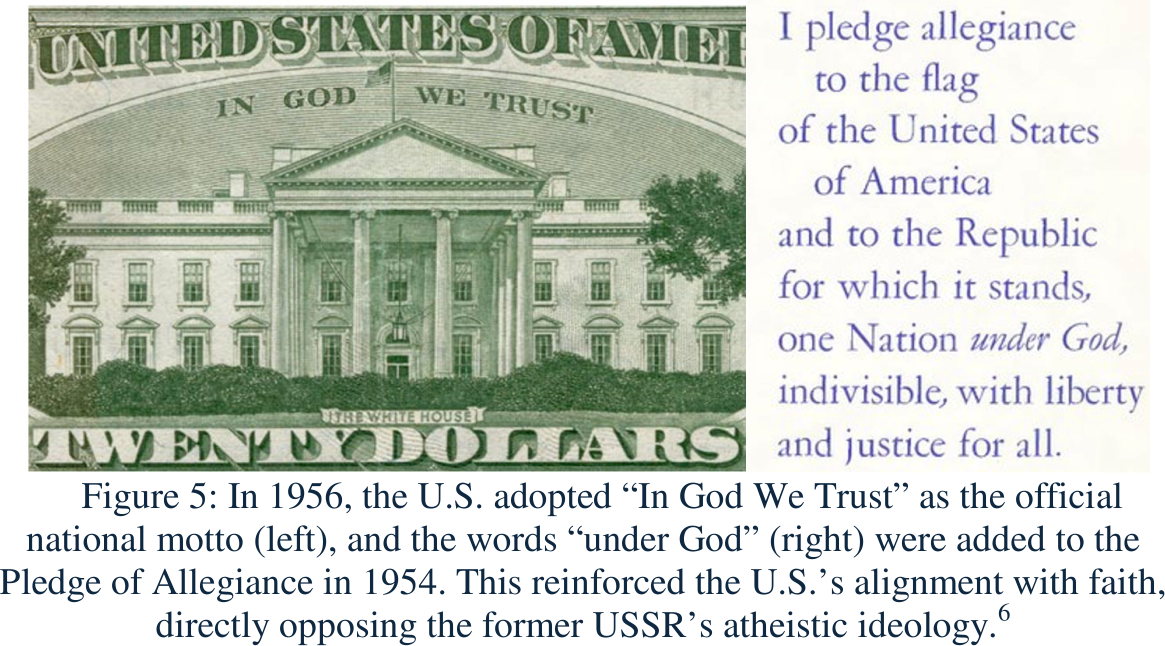
Figure 5: In 1956, the U.S. adopted “In God We Trust” as the
official national motto (left), and the words “under God”
(right) were added to the Pledge of Allegiance in 1954. This
reinforced the U.S.’s alignment with faith, directly
opposing the former USSR’s atheistic ideology.
The search for the Dajjal – Uncovering Soviet manoeuvres
Prophet Jesus (peace be upon him)
searching for the Dajjal in the Hadith
symbolises the United States’ active efforts to identify
communist activities, assess their influence and weaknesses,
and sometimes use military and covert power to contain their
spread. This included military interventions in Korea
(1950-1953) and Vietnam (1955-1975), as well as support for
the anti-Soviet struggle of the Mujahidin in Afghanistan
during the 1980s.
The melting of the Dajjal and blood on the spear – The
Soviet Union’s economic failures and defeat in Afghanistan
The Hadith mentions that the Dajjal
melts away after seeing Prophet Jesus (peace be upon him).
This symbolises that the Soviet Union began to internally
disintegrate from the very start of the Cold War, as
economic failures, political repression, and ideological
disillusionment gradually weakened its strong structure.
The interpretation of the blood on the
lance of Prophet Jesus (peace be upon him) can be seen in
the form of the Mujahidin in Afghanistan, whom the United
States supported. Here, the United States’ indirect
assistance dealt a decisive blow to the Soviet Union, as a
result of which the Soviet Union was severely wounded both
economically and militarily.
The killing of Dajjal at the Gate of Lod – The fall of the
Berlin Wall and the end of the Communist Party’s monopoly
According to the Hadith, Prophet Jesus
(peace be upon him) will kill Dajjal at the Gate of Lod.
Then, Prophet Jesus (peace be upon him) will come to a
nation that has been protected from Dajjal’s tribulation. He
will show them compassion by placing his hand on their faces
and speaking to them about their ranks in Paradise.
During the time of the Prophet Muhammad (peace be upon him),
Lod was an important administrative and trade centre under
the Byzantine Empire, playing a key role in defending
Jerusalem. During the Byzantine-Sassanid War (602–628 CE),
the Sassanids first captured Lod and then advanced towards
Jerusalem, highlighting its strategic significance.
The Berlin Wall held the same strategic
significance as a central pillar of Soviet defensive
strategy during the Cold War. The United States and its
allies turned West Berlin into a symbol of capitalist
success, resulting in an unbearable economic disparity for
the Soviet Union. Ultimately, the fall of the Berlin Wall in
1989 exposed the weaknesses of the Soviet Union and marked
the beginning of the decline of communism in Eastern Europe.
At this historic moment, the United States paid
extraordinary tribute to West Berlin and West Germany, which
had been protected from the tribulation of Dajjal, that is,
communism, and whose people had endured the harshest and
most uncertain conditions for decades with patience and
perseverance.
The Afghan war severely weakened the
Soviet Union internally, and the fall of the Berlin Wall
proved to be the decisive moment when this wound became
fatal. As a result, in 1990, the monopoly of the Communist
Party, which had emerged as a revolutionary force after
Lenin’s return to Russia in 1917 and had ruled unchallenged
since the establishment of the Soviet Union in 1922, ended.
Ultimately, this decline culminated in the complete
dissolution of the Soviet Union in 1991.
Events
after Dajjal in the Hadith
The age of Prophet Jesus (peace be upon
him) is not mentioned in Sahih Al-Bukhari or Sahih Muslim.
However, the seven-year period of peace mentioned in the
Hadith after the death of Dajjal reflects the period from
1991 to 1998.
The world witnessed relative global stability during these
seven years, and the United States emerged as the sole
superpower.
The cool breezes of Syria and Yemen — Comforts of the West
and the Far East
According to the Hadith, seven years
after the slaying of Dajjal, Allah will send a very gentle
and pleasant cool breeze from the direction of Syria
and Yemen,
which will seize from under the armpits.
This pleasant breeze will cause the death of every person
who has even a grain of faith or goodness left in their
heart, and only the wicked will remain on earth. These
people will commit adultery like donkeys, be as light as
birds, dream like wild beasts, worship idols, and become
devoid of any sense of good and evil—despite having an
abundance of comforts and sustenance. It is in this state
that the Day of Judgment will occur.
The death of Dajjal—that is, the
dissolution of the Soviet Union—occurred in December 1991,
and the subsequent seven-year period connects to the end of
the 1990s. This Hadith is interpreted as follows:
· “The cool breeze of Syria” symbolises the influence
of the Western Christian world, just as, during the time of
the Messenger of Allah (peace be upon him), Syria was under
the control of the Byzantine Christian Empire. Just as cool
breezes were considered a sign of comfort and relief in the
scorching deserts of Arabia, in the modern era, the
consumerism, so-called freedom, and material progress of the
Western world—through globalisation and the internet—have
extended their influence to every region of the world and
have ensnared hearts in a particular kind of deceptive
tranquillity.
· “The wind from Yemen, softer than silk,” refers to
East Asian countries, especially China and other industrial
nations. Just as Yemen was considered a major commercial
centre and a source of luxury goods during the Prophetic
era, today’s East Asian countries have become major centres
for material abundance and consumerism worldwide. Their
dominance over global trade routes, particularly their
control over the South China Sea, presents a modern example
of the ancient commercial greatness of Aden and Yemen.
· “The wind seizing believers from under their armpits
and taking their souls” — the armpit is one of the most
sensitive parts of the human body. The fact that the souls
of believers are taken from this point symbolises the
decline of inner virtues due to continuous sensory
overload—a condition in which nonstop stimuli constantly
bombard the eyes, mind, and body through modern technology,
music, new experiences and delicious foods. The abundance of
stimulation and constant pursuit of pleasure has dulled
human sensory perception.
· “Adultery like donkeys” symbolises the decline of
modesty and shame.
· “The swiftness of birds” reflects the carelessness,
haste, and superficiality of human actions, while “dreams
like those of beasts” depict the savagery in their desires
and their alienation from morality.
· “The worship of idols” represents atheism,
materialism, and functional deism, which in the modern world
are large-scale examples of the renewal of polytheism and
idolatry in various forms. Here, as in idol worship, people
make things other than Allah—such as the self, matter, or
human desires—the centre and source of hope in their lives.
Thus, the Hadith presents a scenario of
a world in which, before the Day of Judgment, luxury, the
idolatry of material progress, and alienation from God will
prevail. It will be a world in which the believers are
eliminated and the wicked dominate.
Questions about the Interpretation
Soviet Union Roles in the Second World War and the Cold War
During the Second World War, the Soviet
Union was aligned with the Allied forces and opposed Nazi
Germany (symbolised as Gog and Magog in Hadith). However, in
the post-war era, particularly during the Cold War, the
Soviet Union, as a communist power, continued its
antagonistic stance toward religious belief and moral
values, promoting atheistic communism and rivalling the
United States in global influence, performing the role of
the Dajjal, which may appear contradictory to its earlier
anti-fascist position.
The events described in the Hadith
illustrate how a single entity can play different symbolic
roles depending on the historical context. A similar duality
is found in scriptural history. The Babylonian Empire, for
example, is depicted in the Book of Daniel as a tyrannical
and idolatrous power that desecrated the Temple of Solomon.
Yet in the Qur’an (Surah Bani Isra’il), the same Babylonians
are described as “My servants” when sent by God as an
instrument of punishment against the Israelites.
This Qur’anic statement does not endorse the beliefs of
Babylonians but shows that even oppressive powers can serve
a divine purpose in specific contexts—just as the Soviet
Union, embodying Dajjal-like attributes, was part of the
Allied forces during the Second World War.
These examples suggest that symbolic
figures and empires must be understood within their
historical and theological contexts and not reduced to fixed
or static roles.
Moral issues during the Second World War and the Cold War
The general roles of various states
have been identified in the events of future prophecies
mentioned in Hadith, but the moral approval of every action
of the characters described therein is not guaranteed.
For example, despite the United States’
anti-fascist and anti-communist efforts, the dropping of the
atomic bomb on Japan, indiscriminate bombing in Korea, and
war crimes in Vietnam are historical facts, in which
ordinary citizens were also targeted. From a religious
perspective, these actions cannot be justified morally. The
Hadith does not indicate their moral correctness or
approval.
The United States’ own interests
Did the United States do all this
merely for its interests, or did it consciously play the
role of a messiah? This article suggests that historical
events are not only the result of human intentions; they
become part of divine destiny and align with the signs of
the Day of Judgment. Although the United States’
intervention in the Second World War and the Cold War served
its geographical and economic interests, its actions
unintentionally became a means of fulfilling a larger,
prophesied global narrative.
Smoke
In the Hadith, smoke is described as
one of the major signs of the Day of Judgment, but there is
no further clarification. It is also not mentioned in other
religious scriptures. This event should be prominent
globally for it to be a major sign.
After the Industrial Revolution, the
extraordinary increase in human activities promoted the
excessive use of fossil fuels, which led to the widespread
production of smoke and atmospheric pollution. This
revolution was a significant turning point in human history,
profoundly affecting the environment.
Smoke, smog, and air pollution are now
bitter parts of modern cities, causing health problems,
environmental degradation, and declining quality of life.
These phenomena affect billions of people globally and are
in harmony with the sign of smoke described in the Hadith.
The
Landslides in the East, the West, and the Arabian Peninsula
In Hadith, landslides in the East,
West, and Arabian Peninsula are mentioned as three of the
major signs of the Day of Judgment. The details of these
signs are limited, but rather than restricting their meaning
to just the physical landslides, they can also allude to
social and political crises. These crises may represent
situations where a nation collapses under its own weight due
to internal conflicts and civil war.
In the Book of Revelation, the seven
seals, trumpets, and bowls of wrath represent progressively
intensifying historical events. These events begin after
Jesus (peace be upon him) and reach their peak during the
time of Muhammad (peace be upon him). After the opening of
the seventh seal, there is silence, and the seventh trumpet
symbolises the proclamation of God’s kingdom,
which represents the establishment of the Muslim state
through Muhammad (peace be upon him) and his companions in
the seventh century. Similarly, the seventh bowl of wrath
mentions the destruction of cities, mountains, and islands,
reflecting the downfall of the ruling civilisations of Rome
and Persia.
Since the collapse of social and
political structures has been likened in previous prophecies
to natural disasters, these prophecies may reflect social
and political crises rather than geological events, where
nations are destroyed due to internal conflicts. In this
context, the three possible manifestations of these
prophecies are as follows:
East
(Iraq – 2006)
Iraq experienced social and political
turmoil during the United States’ invasion in 2003 and the
civil war in 2006. These events not only shattered the
political structure but also devastated education, the
economy, healthcare, agriculture, and other essential
sectors, which resembles the landslide described in the
Hadith.
West
(Libya – 2011)
Historically, the West in the Arab
context is associated with North Africa, which aligns with
the collapse of Libya during the Arab Spring in 2011.
Prolonged civil war and political instability in Libya not
only led to the collapse of political institutions but also
crippled the country’s economic output, oil industry,
education system, and other sectors.
Arabian
Peninsula (Yemen – 2014)
Yemen is not historically part of
Arabia proper but part of the Arabian Peninsula.
After the Arab Spring in 2011, Yemen experienced escalating
unrest, culminating in full-scale civil war in 2014. Since
the outbreak of civil war in 2014, Yemen has faced one of
the worst humanitarian crises. There is a lack of
governance, famine, unemployment, the collapse of the
healthcare system, and the closure of educational
institutions, rendering the land seemingly “barren”—a region
that has become not only politically but also practically
“unproductive.”
The landslides have manifested as
comprehensive failure in every aspect of life in all three
locations. After the collapse of Iraq, instability emerged
in Libya and then Yemen, which corresponds to the signs of
the landslides described in the Hadith.
Fire
from Yemen
According to the Hadith, after the
landslide in the Arabian Peninsula, a fire will emerge from
Yemen, specifically from the lower regions of Aden, driving
people towards the Gathering Place—the final place of
assembly. This fire will move with the people; wherever they
stop to rest, it will also halt there.,,
This sign mentioned in the Hadith has
most likely not yet occurred. Like other signs, its purpose
is not to serve as a prediction. These signs should be
understood in the context of the present or the past, rather
than as speculation about the future.
Signs
of the Day of Judgment: Other Important References
Barefoot, unclothed, destitute shepherds will compete in
constructing tall buildings, and a slave girl will give
birth to her mistress.
This sign holds significant importance
because it is mentioned in a Hadith in which Angel Jibril
(Gabriel, peace be upon him) taught the fundamental
principles of the faith.
The first part of the Hadith mentions
“barefoot, unclothed, destitute shepherds” who will compete
to construct tall buildings. This scenario is clearly
observable in the Gulf countries, where, historically,
Bedouin Arabs were known as shepherds, but due to oil
wealth, they are now engaged in building some of the world’s
tallest structures. Dubai’s Burj Khalifa and Saudi Arabia’s
Jeddah Tower are prominent examples of this transformation.
This Hadith reflects the prophecy of their shift from a
humble lifestyle to one of luxury and extravagance.
The second part of the Hadith, “a slave
girl will give birth to her mistress,” points to social
changes, especially following the abolition of slavery. The
formal condemnation of slavery and the promotion of equality
through the Universal Declaration of Human Rights by the
United Nations in 1948 granted former slaves and their
descendants freedom and equal rights. According to this
interpretation, the phrase symbolises the emancipation of
slaves and the achievement of social equality.
Imam
Mahdi
Imam Mahdi is not mentioned in Sahih
Muslim or Sahih Al-Bukhari; therefore, this sign is not
discussed in this article.
A fire
will emerge from Hijaz that will illuminate the necks of
camels in Basra.
A Hadith describes a fire from Hijaz
that will illuminate the necks of camels in Basra.
This event is often mentioned alongside the great sign of
the fire of Yemen, but this incident has already occurred
earlier.
The sign described in the Hadith
occurred in 1256 CE (654 AH), when a major volcanic eruption
took place near Medina in the region of Hijaz. The intensity
of this fire was so great that its light was seen from afar,
to the extent that the necks of camels in Basra were
illuminated at night. This event was documented by
contemporary scholars and historians such as Imam Nawawi and
Ibn Kathir. Their accounts confirm the fulfilment of this
Hadith, which is one of the signs of the Day of Judgment.
The Hadith likely mentions “Hijaz”
instead of “Medina,” so unlike the other signs of the Day of
Judgment associated with Medina, this event would not be
considered a general sign for the entire Muslim community.
The
Romans as the Majority at the Time of the Last Hour
Prophet
Muhammad (peace be upon him) said that the Last Hour would
come when the Romans would form a majority among the people.
He mentioned that they would have these qualities: they
would be patient to undergo trials, quickly regain composure
after trouble, attack again after retreat, be good to the
destitute, orphans, and the weak, and, lastly, resist the
oppression of kings.
This significant prophecy describes an objective condition
that will be fulfilled when the Last Hour arrives.
In the time of
the Prophet Muhammad (peace be upon him), the Byzantine
Christians were referred to as “Romans,” and Christianity
was a prominent part of their identity. Therefore, the
prophecy—that the Romans would be in the majority at the
time of the Last Hour—actually points to the idea that
Christian nations would constitute the majority in the
world. In the present age, Christianity is the largest
religion in the world, fulfilling this condition mentioned
among the signs of the Last Hour.
The remaining
qualities described can also be observed in many Western
countries today, where Christians have shown strong military
resilience in history, established welfare systems for the
destitute and orphans, and actively opposed the oppression
of kings by promoting democracy and constitutional
monarchies in their countries.
Summary
and Acknowledgements
Summary
of the Major Signs of the Day of Judgment
· The Beast of the Land: This symbolises a tyrannical
power that spreads its conquests and influence through land
routes, as opposed to those powers that expand via sea
routes. Its interpretation refers to the Mongol Empire,
which emerged from Central Asia in the 13th century and, at
its height, became a symbol of destruction and terror across
vast territories.
· The Rising of the Sun from the West: This sign
symbolises the rise of Western civilisation, which began
with the Renaissance in the 12th century during the Middle
Ages.
· Dajjal (the False Messiah): This represents a
misleading force that deceives humanity with false promises
of salvation and prosperity while promoting atheism,
oppression, and religious coercion. In history, communist
states represent those thirty (30) Dajjals mentioned in the
Hadiths, with the former Soviet Union playing the most
prominent and central role, emerging as “ad-Dajjal”—the
greatest deceiver.
· Gog and Magog: These nations represent the peoples of
Northern and Western Europe, who, from the 16th to the 20th
centuries, established colonial dominance, exploitation, and
plundering of resources across the world. However, their
colonial supremacy ended as a result of their mutual
conflict—the Second World War. This war not only defeated
fascism but also laid the foundation for the decline of the
colonial system.
· The Descent of Jesus (peace be upon him) (the
Messiah): In the Second World War, the United States played
a decisive role among the European powers—Gog and Magog—emerging
as a saviour force, especially against fascism. Later,
during the Cold War, it assumed a central position against
Dajjal (the Soviet Union) on ideological, military, and
diplomatic fronts. Thus, in the context of these two great
world conflicts, the United States emerged as a symbolic
‘Messiah.’
· The Smoke: Smoke is a metaphor for air pollution and
the environmental crisis following the Industrial
Revolution, which affected billions of people.
· The Landslides (in the East, West, and the Arabian
Peninsula): These have been understood as symbolic
manifestations of sudden social decline, resulting from
political instability and civil wars in various regions. The
events in Iraq (2006) in the East, Libya (2011) in the West,
and Yemen (2014) in the Arabian Peninsula are possible
examples of this.
· Fire from Yemen: This major sign has not yet
appeared. Such symbols should be regarded as an invitation
to reflection rather than a prediction.
Acknowledgements
The development of this framework and
the detailed analysis began with Islamic scholar Javed Ahmad
Ghamidi’s observation that many of the signs of the Day of
Judgment were shown to the Prophet Muhammad (peace be upon
him) in visions.
Later, Adnan Ejaz’s interpretation of the ten signs of the
Day of Judgement gave further direction to this work,
where he introduced a new perspective by interpreting Hadith
prophecies in light of Biblical prophecies.
______________
____________ |